Crypto Trends at the End of 2025: What’s Shaping the Future of Digital Finance

As we approach the end of 2025, the cryptocurrency landscape is evolving faster than ever. Market dynamics, institutional participation, technological innovation, and regulatory shifts have all converged to create a unique environment — one that both seasoned investors and newcomers are watching closely. From Bitcoin price movements to blockchain infrastructure upgrades and real‑world adoption, 2025 has delivered trends that may define the next decade of digital finance.
1. Bitcoin and Market Performance — More Than Just a Store of Value
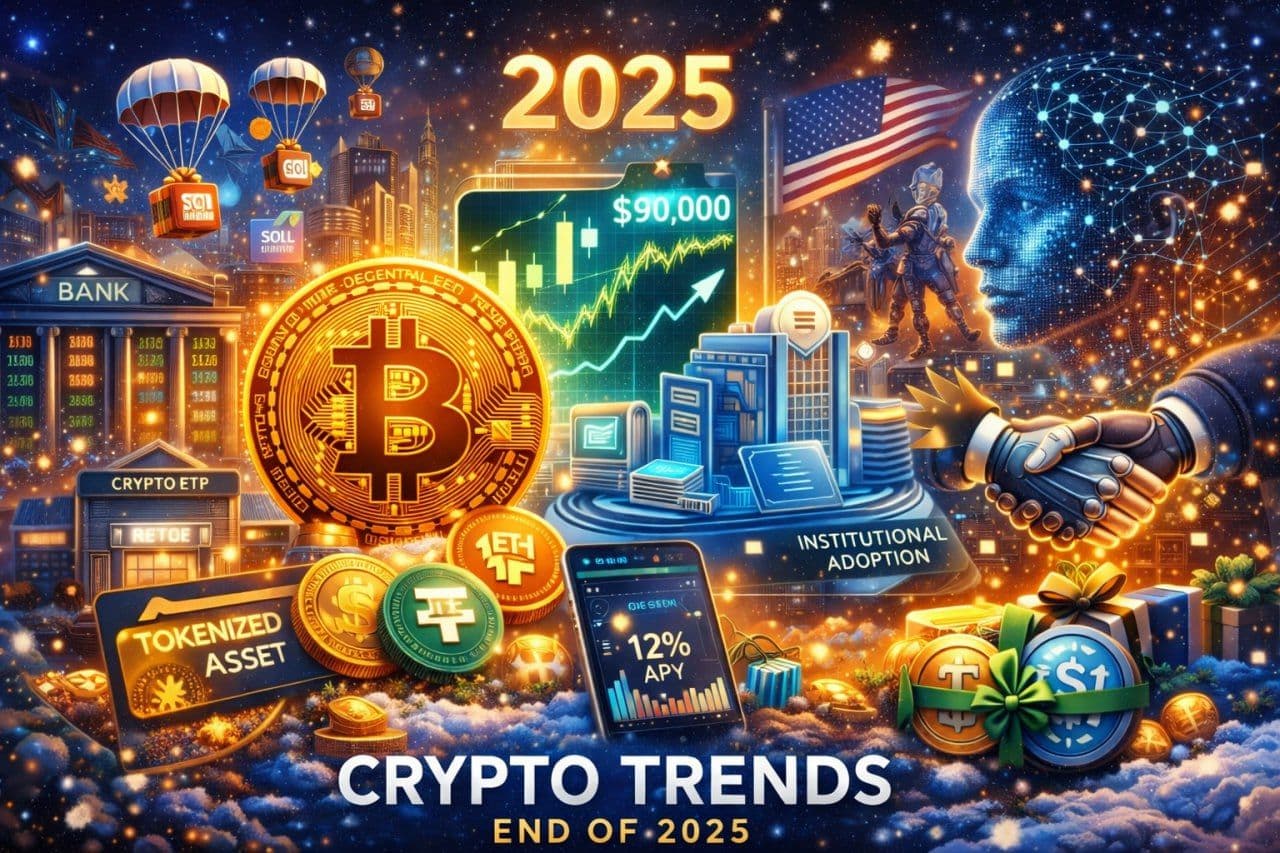
One of the most discussed topics in cryptocurrency this year is the price action of Bitcoin (BTC). As of late 2025, Bitcoin has demonstrated renewed strength, trading around the $90,000 level in a rally that reflects positive market sentiment and increased investor confidence.
While some forecasts early in the year predicted Bitcoin could reach significantly higher price points — even values near $180,000 to $200,000 by the end of 2025 — actual market behavior has been more measured. These predictions were fueled by expectations of spot Bitcoin ETF adoption and institutional inflows.
This trend highlights two key elements: Bitcoin’s continued role as a digital store of value, and how macroeconomic forces — such as inflation worries, investor risk preferences, and regulatory clarity — continue to exert significant influence on its price.
2. Stablecoins and Their Expanding Role
Another unmistakable trend throughout 2025 has been the growth of stablecoins — cryptocurrencies pegged to fiat currencies like the U.S. dollar. Market projections earlier in the year anticipated the stablecoin supply exceeding $400 billion and playing a critical part in cross‑border payments, remittances, and decentralized finance.
Stablecoins have increasingly become the backbone of crypto liquidity and settlement rails for traders and institutions alike. Their stability makes them attractive in volatile markets, and this utility has ensured broader adoption even amid market swings.
3. Institutional Adoption and Traditional Finance Integration
Institutional interest in digital assets has shifted from cautious exploration to more decisive participation in 2025. Major financial entities — including global banks and asset managers — have launched crypto‑linked products and investment funds tokenized on blockchain platforms. For instance, JPMorgan Chase announced its new crypto‑enabled money market fund built on Ethereum, signaling a shift in how traditional finance views digital assets.
These developments suggest that institutional capital is no longer merely observing from the sidelines. Instead, crypto is increasingly being integrated into mainstream investment portfolios, wealth management strategies, and even corporate balance sheets. This trend is expected to continue into 2026 and beyond, especially as regulatory frameworks evolve to accommodate digital asset classes.
4. Blockchain Infrastructure and Layer‑2 Scaling
Technological innovation remains a cornerstone of crypto’s evolution. A major trend in 2025 has been Layer‑2 scaling solutions and enhanced blockchain interoperability. These upgrades aim to reduce costs, improve transaction speeds, and enhance the user experience on decentralized applications (dApps), particularly in decentralized finance (DeFi) and Web3 ecosystems.
Layer‑2 solutions such as rollups (on Ethereum) and similar scaling protocols on other chains have further alleviated congestion and high fees — longstanding barriers to mainstream adoption. Meanwhile, cross‑chain bridges and interoperability standards are helping to connect disparate blockchain networks, offering users seamless movement of assets across platforms.
5. Tokenization of Real‑World Assets (RWAs)
Tokenization — the process of converting real‑world assets into digital tokens on a blockchain — has gained significant momentum. Predictions for 2025 suggested the RWA market could exceed $50 billion, with tokenized real estate, corporate bonds, and other traditional assets unlocking new liquidity and investment models.
The implications of this trend extend beyond financial markets. Tokenized assets make ownership more divisible, transparent, and efficient. Institutional investors and retail participants alike benefit from easier access to asset classes that were once beyond reach due to high minimums or limited liquidity.
6. Web3 Gaming and Digital Economies
Crypto has also forged strong ties with the gaming industry — particularly through Web3 gaming and play‑to‑earn models. By the end of 2025, projections indicated the Web3 gaming ecosystem could be worth tens of billions of dollars, driven by decentralized governance, asset interoperability, and player‑owned economies.
Play‑to‑earn games, in which in‑game assets or native tokens have real value, have attracted a new demographic of users. These digital economies are redefining how gamers interact with content and earn value, further blurring the lines between entertainment and finance.
7. Regulatory Shifts and Global Policy Landscape
Regulatory clarity has been a topic of intense discussion throughout the year. In many jurisdictions, lawmakers and regulators are working to establish frameworks that protect investors while encouraging innovation. One notable trend has been the exploration of state‑level and national crypto initiatives, such as proposals for digital asset reserves and accommodative regulatory regimes.
This regulatory progress is crucial for institutional adoption. Clearer legal frameworks reduce uncertainty and risk, making it easier for banks, insurers, and fund managers to engage with crypto products. However, regulatory divergence between regions remains a challenge — with some countries pushing for strict oversight while others embrace innovation.
8. Blockchain and AI Synergy
A tech trend gaining traction in 2025 is the convergence of artificial intelligence (AI) and blockchain technology. AI‑driven agents and applications are increasingly integrated into decentralized networks, automating complex interactions and optimizing network operations.
This hybrid approach promises to enhance efficiency and unlock new use cases, from predictive analytics in DeFi to intelligent transaction routing. Early experiments with AI agents on blockchain platforms may lay the groundwork for future decentralized autonomous systems that operate with minimal human intervention.
9. Security, Scams, and Regulatory Enforcement
Despite these advances, security remains a pressing concern. High‑profile scams and exploitations continue to surface, particularly on messaging platforms and decentralized applications. Recent analyses have pointed to large darknet markets and cybercrime activity related to crypto, underscoring the need for greater security measures and regulatory cooperation.
As the space matures, enhanced security practices — including better wallet safeguards, KYC/AML standards on centralized exchanges, and institutional‑grade custody solutions — are being adopted more widely. This focus on security is not only crucial for investor protection but also for broader trust in decentralized systems.
10. Community Trends and Retail Participation
Underlying all these macro trends is the ongoing enthusiasm from retail investors and crypto communities worldwide. Surveys and sentiment analyses show that a large percentage of crypto users intend to continue their crypto involvement through 2025 and beyond.
This grassroots support — often driven by decentralized finance innovation, memecoins, and community governance models — helps sustain market activity even during volatile periods. Enthusiasts are not just holding digital assets; they’re participating in governance, creating content, and building decentralized ecosystems of their own.
Conclusion
The end of 2025 finds the crypto industry at a critical juncture — one where institutional adoption, technological innovation, regulatory clarity, and community participation intersect to shape the future of digital finance. From Bitcoin’s market position to stablecoin adoption, tokenized assets, and Web3 gaming, these trends reflect growing maturity and diversification in the crypto ecosystem.
Looking ahead, 2026 and beyond will likely build on these foundations, blending traditional finance and decentralized innovation to create a more inclusive and efficient digital economy.