
Does Betting More Increase Your Chances of Winning?

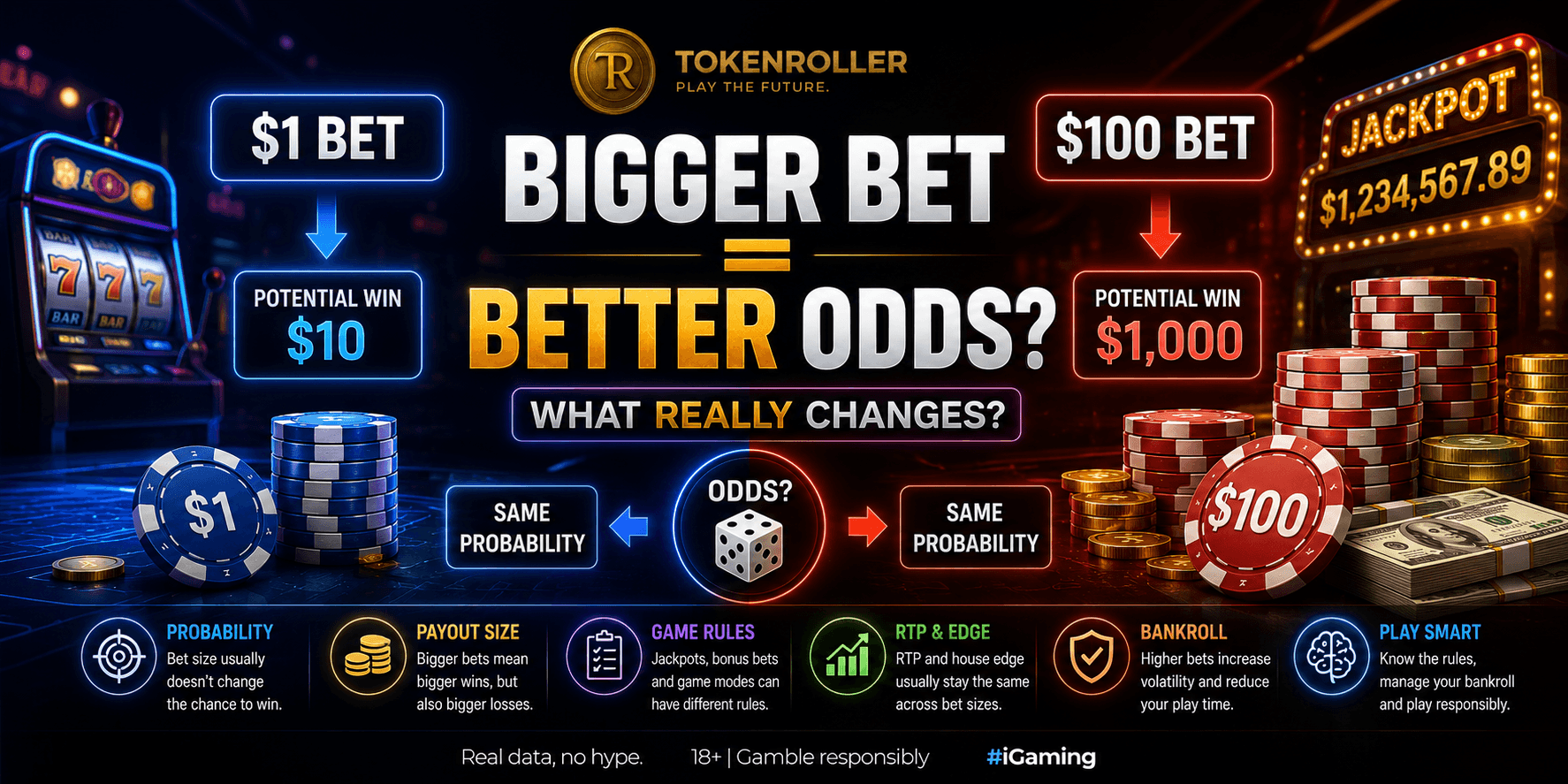
It’s one of the most intuitive assumptions in casino gambling: if you bet more money, surely you must have a better chance of winning. A $10 spin feels more significant than a $1 spin, and when larger wagers produce larger payouts, it’s easy to conclude that the higher stake somehow improved the odds as well. Add stories about players increasing their bets moments before landing a jackpot, and the idea becomes even more convincing.
In most casino games, however, bet size and probability are two different things. Increasing your wager usually changes how much money you can win or lose without changing the underlying chance that a winning outcome will occur. There are some important exceptions—particularly around progressive jackpots, bonus eligibility and games with configurable mathematics—which is why the most accurate answer isn't simply "no." The real answer depends on the rules of the game you're playing.
Bigger Bet, Bigger Payout — Not Necessarily Better Odds
Imagine a simple casino game where a particular winning outcome has a 10% probability. If you wager $1, that probability doesn't automatically become 20% because you increase your next bet to $2. You're simply exposing twice as much money to the same underlying event, with the potential payout typically scaling accordingly.
This distinction between probability and payout is fundamental. Players naturally notice the larger number when a bigger wager wins, but the increased payout doesn't prove that the wager was more likely to succeed. In many slots, dice games and other fixed-probability casino games, changing the stake simply scales the financial result while the mathematical model continues operating in the same way.
That means a player betting $100 isn't necessarily receiving better luck, stronger RNG outcomes or preferential treatment compared with someone betting $1. They're usually just experiencing the same game at a much higher level of financial exposure.
Why Bigger Bets Can Feel More Successful
Our perception of gambling results isn't always a perfect reflection of probability. Large wins are memorable, particularly when they follow an increased wager, while hundreds of ordinary results are easily forgotten. If you raise your stake from $2 to $10 and immediately trigger a strong bonus round, that moment is much more likely to stick in your memory than all the occasions when increasing the bet produced nothing unusual.
This can create a form of confirmation bias. Once a player begins believing that larger wagers "unlock" better results, every successful high-stake spin appears to confirm the theory while unsuccessful ones receive less attention. Over time, an accidental sequence of random outcomes can begin to feel like a reliable strategy.
The same psychological effect helps explain why players sometimes believe certain slots are hot or cold. Humans are extremely good at finding patterns, including patterns that have little or no predictive value.
What Happens to the House Edge?
Increasing a wager generally doesn't make the casino's mathematical advantage disappear. If a game operates with a particular house edge, wagering more money usually means applying that same percentage to a larger amount.
Consider a simplified example. If a game carries a theoretical 2% house edge, the long-term expected cost associated with $10 of wagering is obviously smaller in absolute terms than it is with $1,000 of wagering. The percentage hasn't necessarily changed; the amount of money exposed to it has.
This is why increasing bets after losses can become dangerous so quickly. A larger wager may recover previous losses faster if it wins, but it can also accelerate the losses if it doesn't. The mathematics haven't suddenly become more favorable simply because the player needs a particular result.
There Are Important Exceptions
This is where the answer becomes more nuanced, because not every casino game treats every bet identically.
Some progressive jackpot slots historically required players to place a maximum or qualifying wager to become eligible for the largest jackpot. Modern games vary considerably, so players should always check the specific rules rather than assuming every bet level provides identical jackpot eligibility.
Certain slots can also operate with different configurations or features depending on the stake, game mode or optional bet selected. A "bonus bet," for example, might cost more because it changes access to particular features or modifies some element of the game's mathematics. Likewise, side bets in table games have their own probabilities and house edges rather than simply functioning as larger versions of the original wager.
This doesn't mean that blindly betting more improves your odds. It means you need to distinguish between increasing the size of the same wager and selecting a different wager or game mode with different rules.
The game's information screen and paytable are therefore much more useful than assumptions about how stake size should work.
What About RTP?
RTP adds another layer to the discussion. If a slot has a published theoretical RTP of 96%, increasing the stake from $1 to $10 does not automatically turn it into a 97% or 98% RTP game.
However, players should be aware that some games can exist in multiple RTP configurations, and particular features or betting options may operate under different mathematics. That's why checking the RTP and rules of the version you're actually playing is more reliable than assuming every implementation of a game behaves identically.
Even when the RTP remains exactly the same, a larger wager naturally magnifies the financial swings. Winning $200 feels very different from winning $20, but losing $200 instead of $20 does too. The underlying percentage may be unchanged while the consequences for your bankroll become dramatically larger.
Does Betting More Help With RNG?
A properly implemented Random Number Generator doesn't reward players for increasing their wager because they have recently lost, nor does it decide that a high roller deserves a winning result. The next outcome is generated according to the rules and mathematics of the game.
This is particularly important after a losing streak. Increasing the stake because a win feels "due" combines two separate misconceptions: that previous losses make a future win more likely and that a larger wager somehow improves the probability of that win arriving.
Neither assumption should be made without something in the game's actual rules supporting it.
Bet Size Changes Your Bankroll Faster
For most players, the biggest practical effect of increasing bet size isn't improved probability—it's increased bankroll volatility.
If you have a $200 bankroll and wager $1 per spin, you potentially have far more room to absorb ordinary losing sequences than if you're wagering $20 each time. The higher stake can produce much larger wins, but it can also shorten the session dramatically when results move in the opposite direction.
This is why bet sizing is better viewed as a bankroll-management decision than as a way to manipulate luck. The question shouldn't simply be, "Will betting more help me win?" A more useful question is, "How much of my bankroll am I willing to expose to this outcome?"
Final Thoughts
So, does betting more increase your chances of winning? Usually, increasing the size of the same wager increases the amount at risk and the potential payout rather than automatically improving the underlying probability. But casino games aren't all structured identically, and progressive jackpots, side bets, bonus features and alternative game modes can introduce rules where different wager options have genuinely different conditions.
That's why understanding the specific game matters more than following a universal betting myth.
A bigger bet can create a bigger result, but bigger isn't the same as more likely. Before increasing your stake in search of better odds, check the paytable, RTP information and game rules to find out whether anything about the probability actually changes.
If it doesn't, you're not buying better luck. You're simply putting more money behind the same uncertainty.