
House Edge Explained: What Every Crypto Casino Player Should Know

If you've ever played at a crypto casino, you've probably heard someone mention the house edge.
For many players, the phrase immediately sounds negative. It creates the impression that the casino has some hidden advantage designed to make winning impossible.
The reality is much simpler.
The house edge isn't a secret, nor is it evidence that games are unfair. It's a mathematical concept built into every legitimate casino game, whether you're playing with Bitcoin, stablecoins, or traditional currency.
Understanding how the house edge works can help players set realistic expectations, compare different games more effectively, and make smarter decisions about how they play.
What Is the House Edge?
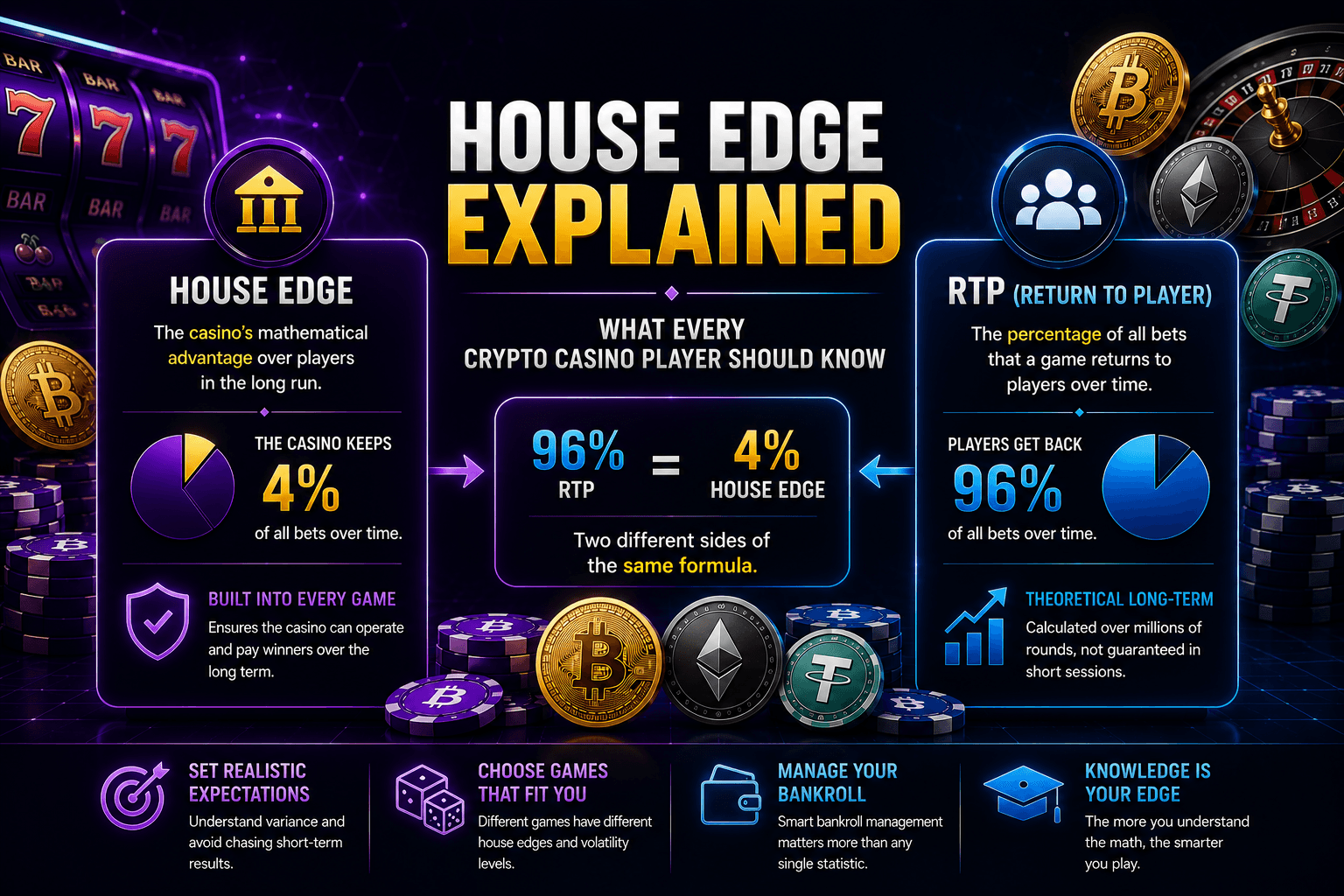
The house edge is the mathematical advantage that a casino has over players in the long run.
Every casino game is designed with a small statistical margin that allows the operator to generate revenue over millions of bets.
For example, imagine a game with a 4% house edge.
Over a very large number of wagers, the casino is expected to keep approximately $4 for every $100 wagered, while the remaining $96 is returned to players through winnings.
That doesn't mean every player loses exactly 4%, nor does it mean the casino wins every session.
The house edge is simply a long-term mathematical expectation.
House Edge and RTP Are Closely Connected
Players often see Return to Player (RTP) displayed in game information, while the house edge receives much less attention.
The two concepts are directly related.
If a game has:
- 96% RTP
- 4% House Edge
Both numbers describe the same mathematical model from different perspectives.
RTP focuses on what is expected to return to players over time.
House edge focuses on the portion expected to remain with the casino.
Neither statistic predicts what will happen during your next spin or hand.
They only describe how the game behaves over an extremely large sample of play.
Why the House Edge Doesn't Mean Games Are Rigged
One of the biggest misconceptions among new players is believing that the house edge means casinos manipulate results.
Legitimate crypto casinos don't need to alter outcomes to remain profitable.
Games already contain a built-in statistical advantage.
When fair random number generators or provably fair systems are used, every result remains genuinely random. The casino simply relies on mathematics rather than manipulation.
This distinction is important.
A fair game can still have a house edge.
Random outcomes and long-term probability can exist at the same time.
Short Sessions Can Produce Unexpected Results
One reason the house edge is often misunderstood is because players experience relatively small samples.
A player might win a jackpot within minutes.
Another may lose several sessions in a row.
Neither outcome proves the published house edge is incorrect.
Probability doesn't distribute results evenly across short sessions.
Instead, the expected advantage becomes more visible only after thousands—or even millions—of rounds.
That's why casinos can confidently offer games while individual players still experience dramatic wins.
Different Games Have Different House Edges
Not every casino game offers the same mathematical advantage.
Some games are designed with relatively low house edges, while others provide significantly larger margins for the casino.
Table games such as blackjack and baccarat are often known for relatively low house edges when played using optimal strategy.
Many slot games, on the other hand, vary depending on their RTP settings and design.
Understanding these differences allows players to compare games beyond flashy graphics or bonus features.
The game itself often has a greater impact on long-term expectations than the size of a welcome bonus.
Does Cryptocurrency Change the House Edge?
This is another common misconception.
Whether you wager using Bitcoin, Ethereum, USDT, or traditional currency has no effect on the house edge.
The mathematics behind the game remain exactly the same.
What cryptocurrency can change is the overall playing experience.
Faster withdrawals, lower transaction fees, and improved payment flexibility are all benefits of crypto casinos—but they don't influence the statistical odds built into the games.
A 96% RTP slot remains a 96% RTP slot regardless of the currency being used.
Why Understanding the House Edge Matters
Learning about the house edge isn't about removing risk.
Casino games are designed to be entertaining first and foremost.
However, understanding the mathematics behind them helps players develop realistic expectations.
Instead of believing every session should produce profits, experienced players recognize that short-term variance can move in either direction.
The house edge simply explains what happens over the long run.
That knowledge often leads to better bankroll management and more informed game selection.
Looking Beyond the Numbers
While house edge is an important statistic, it shouldn't be the only factor players consider.
Volatility, RTP, game mechanics, payment reliability, and overall casino reputation all contribute to the complete experience.
Understanding each of these concepts together provides a much clearer picture than relying on any single metric.
Knowledge doesn't eliminate uncertainty—but it does help players approach crypto casinos with greater confidence.
Final Thoughts
The house edge is one of the most fundamental concepts in gambling, yet it's often misunderstood.
It doesn't mean games are unfair, nor does it guarantee that players will lose every session.
Instead, it represents the long-term mathematical advantage that allows casinos to operate while still offering players the possibility of significant wins.
By understanding how the house edge relates to RTP, volatility, and randomness, players can make more informed decisions and better appreciate how crypto casino games are designed.
The more you understand the math, the easier it becomes to separate myths from reality.